

Published November 15, 2026
Author Source EEAT Authors · Mike's Author Page
Prices updated November 2026. The price, the screw spacing and the warranty come from Prime Line's own product page. Run the free diagnostic tests below before you purchase anything, since each one takes less than a minute and usually identifies the actual problem.
- Work the latch with the door openIf the hook extends and retracts smoothly, the lock is probably fine and the problem is located where it meets the frame.
- Lift the door and try againIf it locks while you lift the handle side, the panel has probably dropped on worn or misadjusted rollers.
- Move the strike before you buy partsMany strikes have screws that let them slide up or down to meet the hook.
- Match the old lock exactlySliding door locks are not universal, so bring the original lock when you shop for a replacement.
- Pool doors have county rulesClark County Fire says doors to a pool or spa must be alarmed, self closing and self latching.
Find Your Answer5 steps
Find Out What Is Actually Failing
A sliding door lock is a spring loaded hook mounted inside the edge of the moving panel. When you flip the lever, the hook swings out and grabs a metal strike attached to the door frame. The lock can only function when the hook and the strike meet at exactly the same height.
So begin the diagnosis with the door standing open. Flip the lever several times and watch the hook carefully. If it extends fully and retracts every time, the lock mechanism is doing its job.
Now close the door slowly and observe where the hook lands. Fresh scratches above or below the strike opening indicate the hook is hitting metal instead of entering the hole. That is an alignment problem, and a brand new lock would land in exactly the same incorrect position.
Next, lift the handle side of the door slightly and try the lever again. If it catches while you lift, the rollers underneath the panel have settled or worn down. If the lever turns but the hook never moves, even with the door open, the lock or its handle has failed inside.
| What you notice | Likely cause | First fix |
|---|---|---|
| Hook works with the door open, misses when closed | Strike out of line | Slide the strike up or down |
| Locks only while you lift the door | Rollers low or worn | Raise the rollers or replace them |
| Door drags or grinds in the track | Dirt or a dent in the track | Vacuum and clean the track |
| Lever turns but the hook never moves | Broken lock or handle part | Replace the lock |
| Lever feels loose or sits crooked | Loose handle screws | Tighten the handle gently |
| Hook will not stay out | Worn spring in the lock | Replace the lock |
Line Up the Door and the Strike First
Clean the bottom track thoroughly before you adjust anything else. Las Vegas dust accumulates in that track quickly, and a door riding on packed grit sits lower than the manufacturer intended. The same fine dust is behind most of the stiff front door locks in our sticky lock guide. A vacuum and a stiff brush handle most of the cleaning.
Then look at the strike on the frame. On Milgard doors, the hook has to land on the Milgard logo printed on the strike cap, according to a Milgard dealer's adjustment guide. If it lands above or below the logo, the lock will not engage.
The same guide lists the necessary tools as a putty knife and a Phillips screwdriver. You remove the cover plate, loosen the adjustment screw along with the screws above and below it, and reposition the strike until it meets the hook. Then tighten everything and test the lock several times.
Other manufacturers use slotted mounting holes in the strike for the same purpose. Move the strike in small increments and test the lock after each adjustment. Never force a bigger screw into an aluminum frame, because a stripped hole leaves the strike with nothing to hold it.
If the door itself sits low, the solution is in the rollers. Many sliders have adjustment screws near the bottom corners of the moving panel, so turn each one gradually and keep the door level. A door that continues to drop after adjustment usually needs replacement rollers.
When the Lock Itself Has to Go
Replace the lock only when the hook fails while the door is standing wide open. That usually means the lever spins without moving the hook, the hook will not stay extended, or a broken component rattles loose inside the edge of the panel.
Many sliders use a mortise lock, which is a small steel box installed inside the edge of the moving panel and operated by the handle on each side. Prime Line sells its E 2014 for $13.47, with mounting holes 3 11/16 inches apart and a one year warranty against defects, on its product page.
That page also shows why guessing fails. The E 2014 is built for handle sets with a 45 degree keyway, and Prime Line tells buyers to remove the existing lock and compare it before they order. Screw spacing, the faceplate shape and the hook direction all have to match.
So remove the old lock first, with the door open, and carry it to the hardware store for comparison. A replacement that looks similar but sits a few millimeters off will never reach the strike, and you end up back where you started with an extra part in the drawer.
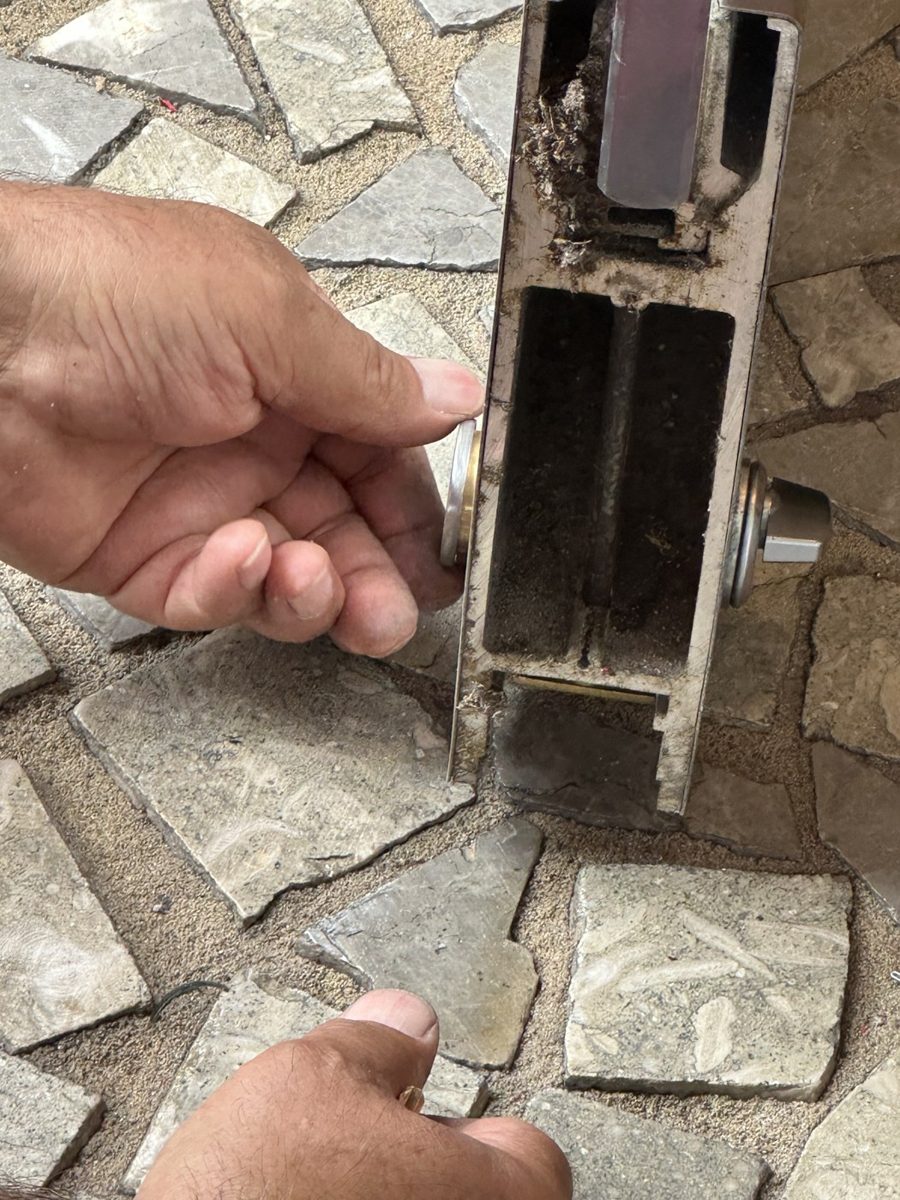
Dirt matters here too. The photo below shows a lock case we pulled from an aluminum door in Las Vegas, packed with years of grit around the moving parts. Cleaning the pocket before the new lock goes in keeps that grit from jamming the new hook.
| Situation | Repair | Replace |
|---|---|---|
| Hook works open, misses closed | Yes, move the strike | No |
| Door sits low on its rollers | Yes, raise or swap the rollers | No |
| Handle loose, lock fine | Yes, tighten the handle | No |
| Hook dead with the door open | No | Yes, match the old lock |
| Handle cracked or spindle worn | Sometimes | Often the handle set |
| Lock rusted or bent after a forced entry | No | Yes, and check the frame |
Pool Doors in Clark County Need More Than a Latch
Many Las Vegas sliders open onto a backyard pool, and that changes the stakes. The Clark County Fire Department says doors and windows that lead to a pool or spa must be alarmed. It also says doors and gates must be self closing and self latching.
The reason is how quickly a drowning can happen. The same county page says the most common drowning victim is a child four years old or younger, and that most drowning deaths happen in the family pool. It also says 70 percent of incidents happen between 2 p.m. and 8 p.m.
A slider that does not latch fails that requirement, even if nobody in the household notices for weeks. A curious child can easily pull open a door that only appears closed, so repairing the latch on a pool door is a safety priority rather than a weekend chore.
Inspect the door alarm while you are working on the slider, and if it chimes when the door opens, test it every month. If the door stays latched only when someone remembers to push it closed, add a second lock mounted high, out of a small child's reach.
Make the Slider Harder to Force
A functioning latch is the beginning of a secure slider, not the finish. At a Las Vegas community safety forum, a Las Vegas police officer called sliding doors an easy target and said the factory locks are not enough, KTNV reported. The officer suggested a small metal rod at the bottom of the door.
The King County Sheriff's Office gives the same advice in more detail. A wooden dowel or a metal bar in the track stops the door from sliding open. The office also warns that older sliders can be lifted up and off their track, which defeats the latch.
For that, the sheriff's page describes a pin that passes through both the moving panel and the fixed one. With the pin in place, the door cannot be lifted out or slid open. Keep it easy to pull from inside, because you may need the slider as a way out.
We repair and replace sliding glass door locks across the valley, and we can fit a secondary lock on the frame when the factory hook is not enough. If you rent, read our guide to Nevada lock rules for tenants before you drill into a frame you do not own.
Many people fix the slider and then rekey the rest of the house in the same visit, so one key covers every door. Residential rekeys start at $79, and our house lockout service runs around the clock if the slider is the only door left unlocked.
Make Silver State Locksmith a preferred Google source
Loose Ends
Why is my sliding door not locking?
Usually the hook misses the strike because the door has dropped or the strike has shifted position. Test the lever with the door open, and if the hook operates normally, adjust the strike or the rollers before you purchase a new lock.
How much is a lock for a sliding glass door?
Prime Line lists its E 2014 replacement mortise lock at $13.47. The correct part depends on your particular door, so compare the original lock carefully before you purchase one.
Are sliding door locks universal?
No. Screw spacing, faceplate shape, hook direction and the handle keyway all vary. Prime Line tells buyers to remove the old lock and compare it before ordering.
Can you add a second lock to a sliding glass door?
Yes. A bar or dowel in the track prevents the door from sliding, and a pin through both panels prevents someone from lifting it out. Both should be easy to remove from inside the house.
Do pool doors in Las Vegas need an alarm?
Clark County Fire says doors and windows that lead to a pool or spa must be alarmed, and doors must be self closing and self latching.
Slider still not latching? See our residential locksmith service, how to fix a sticky door lock and the best locks for a Las Vegas home, or call (725) 280‑5051 any hour and we will give you the price before we start.
Original Documents
- Prime Line, Mortise Lock E 2014 for Sliding Patio Doors
- US Window and Door, How To Adjust a Sliding Glass Door Lock and Handle
- Clark County Fire Department, Swimming Pools and Drowning Prevention
- KTNV Las Vegas, How to Prevent Burglars From Breaking Into Your Home
- King County Sheriff's Office, Doors and Locks
Locked Out? We Can Help, Day or Night
Silver State Locksmith is available 24/7 across the Las Vegas valley. Fast response, transparent pricing, licensed & insured technicians.
Call (725) 280-5051 Now Request Service